LangChain vs LangGraph: Architecting Stateful Multi-Agent Systems
The landscape of building LLM-powered applications is evolving rapidly. We've moved from simple prompt engineering to complex "chains," and now we're entering the era of truly agentic, multi-agent systems.
When you're architecting these systems, the choice between LangChain and LangGraph is critical. While they share a lineage, their architectural foundations are built for fundamentally different use cases.
The Architectural Divide: Linear vs. Cyclic
At its core, the difference is one of topology: Linear Chains vs. Cyclic Graphs.
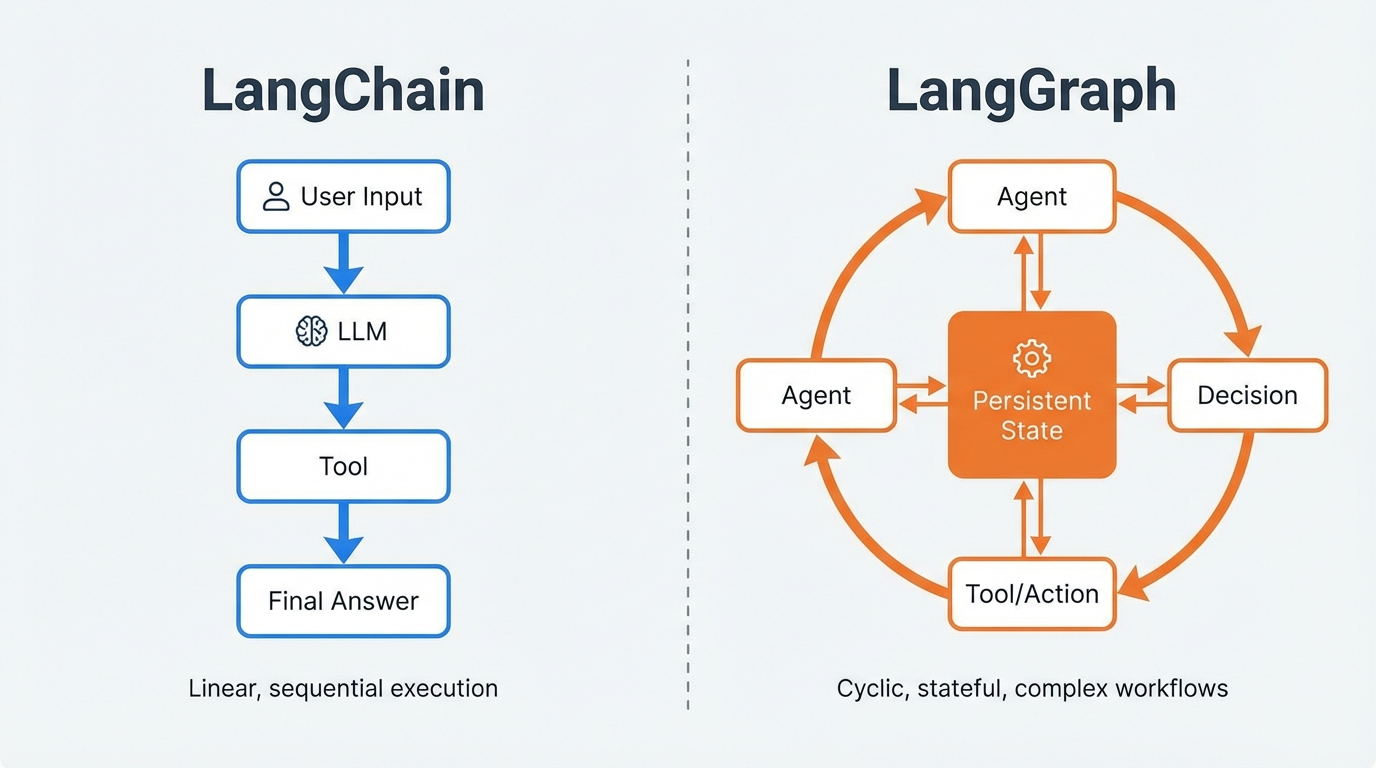
| Feature | LangChain (Chains) | LangGraph (Graphs) |
|---|---|---|
| Topology | Directed Acyclic Graph (DAG) | Cyclic Graph |
| Flow | Linear / Sequential | Looping / Iterative |
| State | Implicit / Append-only | Explicit / Schema-based |
| Cycles | Not natively supported | First-class citizen |
| Persistence | Basic memory buffers | Checkpointing / Time Travel |
LangChain: The Linear Evolution
LangChain is built around the concept of a DAG. You define a sequence of steps—a "chain"—where data flows from one component to the next in a predetermined path. It’s excellent for straightforward transformations and simple RAG (Retrieval-Augmented Generation).
LangGraph: The Agentic Revolution
LangGraph is designed for stateful, cyclic workflows. Instead of a fixed sequence, you define a graph where Nodes represent actions (LLM calls, tools) and Edges define transitions.
Control Flow & Decision Making
Transitions in LangGraph aren't just direct; you use Conditional Edges (routers) to make real-time decisions. For example, a router node can analyze an LLM's output and decide whether to call a tool or move to a final response node.
Advanced State Management
One of the most significant upgrades in LangGraph is how it treats state.
Explicit State Schemas
In LangGraph, you define a State object (using TypedDict or Pydantic). This provides a single source of truth that is passed between every node in the graph.
ReducedValue: Allows you to define custom state reducers (e.g., merging a list of messages instead of overwriting).UntrackedValue: Useful for transient data that needs to be accessible within a node but shouldn't be persisted in the graph's history.
Reliability: Persistence & Human-in-the-Loop
Checkpoints and Time Travel
LangGraph includes built-in Persistence. Every step of the graph is checkpointed. If a system crashes, you can resume exactly where you left off. This also enables Time Travel, allowing you to "rewind" to a previous state, inspect what the agent was thinking, and even branch into a new execution path.
Interrupts
For sensitive actions (like executing a shell command or making a transaction), LangGraph supports Interrupts. You can pause the graph, wait for a human to approve the action, and then resume.
Multi-Agent Architecture Patterns
When scaling to multiple agents, LangGraph supports three primary patterns:
- Supervisor: A central manager agent delegates tasks to specialized workers.
- Collaborative: Agents share a common state and pass control back and forth directly.
- Swarm: A decentralized collection of agents that coordinate through shared memory and triggers.
Practical Example: The Self-Correction Loop
A classic use case for LangGraph is a Self-Correction Loop:
- Agent Node: Generates code.
- Test Node: Executes the code and runs unit tests.
- Conditional Edge: If tests pass, move to End. If they fail, route back to the Agent Node with the error log for a fix.
Security & Stability (March 2026 Update)
Stability is as important as architecture. As of March 2026, several critical security advisories have been released concerning AI framework vulnerabilities:
- CVE-2026-34070: Path Traversal in legacy prompt loading.
- CVE-2025-68664: Serialization injection in
dumps()andload(). - CVE-2025-67644: Unsafe deserialization of LLM-influenced metadata.
To mitigate these, ensure your systems are running langchain-core (1.2.22+) and langgraph-checkpoint-sqlite (3.0.1+). These versions deprecate unsafe legacy functions and introduce stricter validation for deserialized objects.
Choosing the Right Tool
- Choose LangChain if your workflow is a clear, step-by-step process. It’s faster to prototype and easier for simple tasks.
- Choose LangGraph if your application needs to handle complex decisions, requires cycles/looping, or needs persistent, reliable execution.
The future of AI is about the sophisticated architectures we build around them. Moving from chains to graphs is the first step toward building truly intelligent systems.
About the author: Rohit Marathe is an AI Systems Engineer specializing in multi-agent orchestration and large-scale LLM deployments.
- ← Previous
Multi-Turn Conversation with LLM